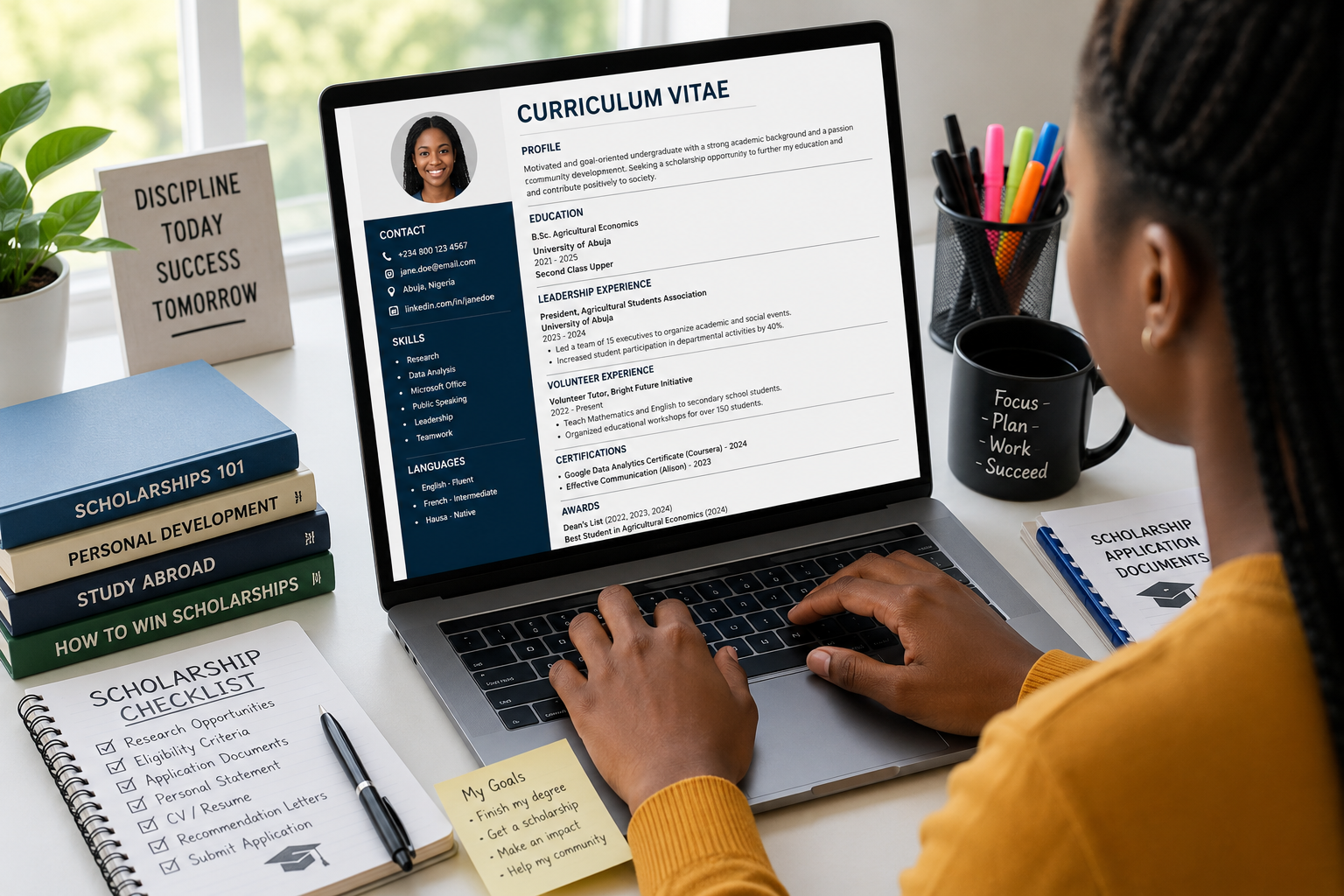
A scholarship CV is often the first impression you make on a scholarship committee, long before they read your personal statement or recommendation letters. Within a matter of minutes—sometimes even seconds—they begin forming opinions about your achievements, your potential, and whether you deserve to move to the next stage of the selection process.
That may sound intimidating.
Fortunately, it also presents an opportunity.
A well-written scholarship CV does much more than list qualifications. It tells the story of a student who is prepared, intentional, and capable of making the most of an educational opportunity. It highlights academic excellence, leadership, service, and personal growth in a way that is easy to understand and difficult to ignore.
Unfortunately, many applicants misunderstand what a scholarship CV should accomplish.
Some submit the same résumé they use for job applications.
Others overload their CVs with unnecessary details.
Some omit achievements that could have distinguished them from hundreds—or even thousands—of other applicants.
The result is predictable.
Excellent students are rejected, not because they lack ability, but because their applications fail to communicate their strengths effectively.
The encouraging news is that writing a compelling scholarship CV is a skill that can be learned.
You do not need years of professional experience.
You do not need dozens of certificates.
And you certainly do not need to exaggerate your accomplishments.
What you need is clarity, organization, and an understanding of what scholarship reviewers are actually looking for.
This comprehensive guide will walk you through every step of creating a scholarship CV that strengthens your application and increases your chances of success.
Table of Contents
- What Is a Scholarship CV?
- Scholarship CV vs Job Resume
- Why Your CV Matters More Than You Think
- What Scholarship Committees Look For
- Best Scholarship CV Format
- Step-by-Step Guide to Writing a Scholarship CV
- Scholarship CV Example
- Common Mistakes That Lead to Rejection
- How to Make Your CV Stand Out
- Frequently Asked Questions
- Final Thoughts
What Is a Scholarship CV?
A scholarship CV is a document that summarizes your academic background, achievements, skills, leadership experience, volunteer work, awards, and other accomplishments that demonstrate your suitability for a scholarship.
Unlike a job résumé, which is designed to convince an employer to hire you, a scholarship CV is designed to convince a scholarship committee that investing in your education will produce meaningful results.
That distinction is important.
Employers often prioritize professional experience.
Scholarship providers usually look for academic promise, leadership potential, community involvement, integrity, and evidence that you will make good use of the opportunity they are offering.
Think of your scholarship CV as a carefully organized snapshot of your educational journey.
Every section should help answer one question:
“Why should we invest in this student?”
Scholarship CV vs Job Resume
Many applicants assume the two documents are identical.
They are not.
Although both summarize your qualifications, they serve different purposes.
| Scholarship CV vs Job | b Resume |
|---|---|
| Focuses on academic achievements | Focuses on professional experience |
| Highlights leadership and volunteer work | Highlights work performance |
| Includes scholarships, awards, and research | Includes employment history |
| Demonstrates learning potential | Demonstrates ability to perform a job |
| Often slightly longer | Usually shorter |
Understanding this difference prevents one of the most common mistakes applicants make: submitting a job résumé for a scholarship application.
Why Your Scholarship CV Matters More Than You Think
Imagine reviewing 2,000 scholarship applications.
Every applicant claims to be hardworking.
Every applicant says education is important.
Every applicant dreams of making a difference.
How does the committee begin separating outstanding candidates from average ones?
Your CV provides the answer.
It offers tangible evidence.
Instead of merely saying you are a leader, your CV shows the leadership roles you have held.
Instead of saying you are committed to service, it lists volunteer projects and measurable contributions.
Instead of claiming academic excellence, it presents your grades, awards, and research achievements.
In other words, your CV transforms claims into proof.
That is precisely what reviewers need.
What Scholarship Committees Really Look For
Many applicants assume scholarship committees only care about grades.
Strong academic performance certainly matters.
However, it is rarely the only factor.
Most scholarship providers evaluate applicants holistically.
They want to understand the person behind the transcript.
Some of the qualities they commonly assess include:
Academic Excellence
Your educational performance demonstrates your ability to succeed in demanding academic environments.
Even if your grades are not perfect, evidence of consistent improvement can leave a positive impression.
Leadership
Leadership is not limited to student union presidents.
Perhaps you organized a community project.
Mentored younger students.
Led a study group.
Started a small initiative in your neighborhood.
Leadership appears in many forms.
Community Service
Scholarship organizations frequently invest in individuals who contribute positively to society.
Volunteer work, charity activities, mentoring, environmental projects, and social initiatives all demonstrate this quality.
Personal Initiative
Committees appreciate applicants who create opportunities instead of waiting for them.
This could include:
- Online certifications
- Personal research
- Academic competitions
- Independent projects
- Entrepreneurship
- Creative work
Initiative often distinguishes exceptional applicants.
Communication Skills
A clear, organized CV reflects professionalism.
If your document is confusing, poorly structured, or filled with errors, reviewers may question the care you will bring to other responsibilities.
Choosing the Best Scholarship CV Format
Presentation matters.
A cluttered CV discourages reading.
A clean layout encourages it.
Your scholarship CV should generally include these sections in this order:
Contact Information
Include:
- Full name
- Email address
- Phone number
- Country
- LinkedIn profile (optional)
- Professional portfolio (if applicable)
Avoid including unnecessary personal details such as religion, marital status, or passport number unless specifically requested.
Professional Profile
Write a short introduction consisting of three or four sentences.
This section should summarize:
- Academic interests
- Career goals
- Major strengths
- Educational aspirations
Example:
“Motivated undergraduate student pursuing a degree in Agricultural Economics with a strong interest in food security, leadership, and sustainable development. Passionate about community service and committed to using education to improve rural livelihoods.”
Education
List:
- Institution
- Degree
- Graduation year
- GPA (if strong)
- Academic distinctions
Always begin with the most recent qualification.
Academic Achievements
This section may include:
- Dean’s List
- Merit awards
- Scholarships
- Research projects
- Academic competitions
- Published papers
- Conference presentations
Academic accomplishments deserve visibility because they demonstrate consistency and commitment.
Leadership Experience
Scholarship providers are interested in applicants who can influence others positively.
Do not assume you have no leadership experience simply because you have never held a formal title.
Leadership can come from many situations.
Perhaps you coordinated a class assignment.
Organized a community sanitation exercise.
Served as a church youth leader.
Managed a campus association.
Started a reading club.
Even mentoring younger students demonstrates leadership.
When listing each role, avoid merely stating the position you held. Briefly explain what you accomplished.
Instead of writing:
Class Representative
Write:
Class Representative – Department of Economics (2024–2025)
- Coordinated communication between lecturers and over 120 students.
- Organized revision sessions before examinations.
- Helped resolve academic concerns raised by classmates.
Notice the difference.
The second example shows impact rather than simply responsibility.
Volunteer Experience
Many scholarship organizations value service because it demonstrates compassion, responsibility, and a willingness to contribute beyond personal interests.
Include volunteer work such as:
- Teaching in community schools
- Environmental projects
- Charity events
- Health awareness campaigns
- Religious outreach
- NGO activities
- Youth mentoring
- Literacy programmes
Whenever possible, describe measurable outcomes.
For example:
Volunteer Tutor – Bright Future Initiative
- Taught Mathematics to secondary school students every weekend for six months.
- Helped improve examination pass rates among participating students.
- Assisted in organizing educational workshops for over 150 students.
Specific achievements always carry more weight than vague descriptions.
Work Experience (If Applicable)
Many scholarship applicants have little or no professional experience.
That is perfectly acceptable.
If you have worked before, however, include only experiences that demonstrate transferable skills.
Examples include:
- Internship
- Graduate trainee programme
- Part-time employment
- Freelancing
- Campus employment
- Family business responsibilities
Focus on achievements rather than job duties.
For example:
Administrative Assistant
Instead of saying:
- Filed documents.
- Answered phone calls.
Write:
- Improved document filing efficiency by introducing a digital record system.
- Assisted in coordinating meetings involving multiple departments.
Even small accomplishments become valuable when explained properly.
Skills Section
Avoid creating an endless list of generic abilities.
Choose skills relevant to academic success and leadership.
Examples include:
Technical Skills
- Microsoft Word
- Microsoft Excel
- PowerPoint
- Google Workspace
- SPSS
- MATLAB
- Python
- Data Analysis
Soft Skills
- Leadership
- Communication
- Public speaking
- Critical thinking
- Problem-solving
- Teamwork
- Time management
- Research
Remember:
It is better to list eight strong skills than thirty meaningless ones.
Certifications
Scholarship committees appreciate applicants who continue learning outside the classroom.
Include certifications from recognized platforms.
Examples include:
- Google Career Certificates
- Coursera
- edX
- FutureLearn
- LinkedIn Learning
- Alison
- Udemy (where relevant)
List:
- Certificate title
- Issuing organization
- Year completed
Languages
If you speak more than one language, include them.
Example:
- English — Fluent
- French — Intermediate
- Arabic — Basic
- Spanish — Conversational
Language ability can become an advantage, especially for international scholarship programmes.
Scholarship CV Example
Below is a simplified example.
John Akaahar
Email: john@email.com
Phone: +234 XXX XXX XXXX
Country: Nigeria
Professional Profile
Highly motivated Agricultural Economics graduate passionate about food security, sustainable agriculture, and youth empowerment. Demonstrated leadership through community service, academic excellence, and volunteer initiatives. Seeking a fully funded master’s scholarship to expand research capacity and contribute to agricultural development across Africa.
Education
Bachelor of Agriculture
University of Abuja
First Class Honours
2025
Academic Achievements
- Best Graduating Student (Department)
- Dean’s Honour List
- Winner, National Essay Competition
Leadership Experience
President, Agricultural Students Association
- Led over 300 students.
- Organized academic seminars.
- Increased student participation in departmental programmes.
Volunteer Experience
Teach for Community Initiative
- Mentored secondary school students.
- Organized educational outreach programmes.
Skills
- Research
- Academic Writing
- Microsoft Office
- Public Speaking
- Leadership
- Data Analysis
Certifications
Google Data Analytics Certificate
Coursera
2025
Common Scholarship CV Mistakes
Many applications are weakened by avoidable errors.
Here are some of the most common.
Including Irrelevant Information
Your favourite colour.
Your weight.
Religion.
Parents’ occupations.
These details are usually unnecessary unless specifically requested.
Keep your CV focused.
Poor Formatting
Different fonts.
Random colors.
Uneven spacing.
Crowded pages.
A scholarship CV should look clean and professional.
Consistency creates a positive first impression.
Grammatical Errors
Simple mistakes reduce credibility.
Always proofread.
Better still, ask someone else to review your CV before submission.
Fresh eyes often notice errors you overlook.
Exaggerating Achievements
Never claim accomplishments you cannot defend during an interview.
Scholarship committees frequently verify information.
Honesty remains your strongest asset.
Using One CV for Every Scholarship
Different scholarships prioritize different qualities.
A research scholarship may value publications.
A leadership scholarship may emphasize community service.
Adjust your CV to reflect the priorities of each opportunity.
How to Make Your Scholarship CV Stand Out
Competition for scholarships continues to increase every year.
To stand out:
Quantify Your Achievements
Instead of writing:
“Participated in community service.”
Write:
“Coordinated a literacy programme that reached over 200 secondary school students.”
Numbers create stronger evidence.
Show Growth
Reviewers appreciate applicants who continue improving.
Highlight progression in academics, leadership, and community involvement.
Growth demonstrates commitment.
Keep It Concise
Aim for one to two pages unless the scholarship specifically requests a detailed academic CV.
Every sentence should earn its place.
Tailor Every Application
Read the scholarship requirements carefully.
Adjust your CV so that the most relevant experiences appear prominently.
A customized CV almost always performs better than a generic one.
Final Thoughts
A scholarship CV is much more than a list of schools attended and certificates earned.
It is a carefully structured narrative of your academic journey.
It shows where you have been.
It reflects what you value.
More importantly, it helps scholarship committees imagine what you might accomplish if they invest in your education.
Remember that most applicants possess similar qualifications on paper.
What often separates successful candidates is not extraordinary brilliance but thoughtful presentation.
A clear structure, honest achievements, measurable impact, and careful attention to detail can transform an ordinary application into one that commands attention.
Take time to refine your CV.
Update it regularly.
Seek feedback from lecturers, mentors, or professionals you trust.
Every revision makes it stronger.
The effort you invest today may become the opportunity that changes your future tomorrow.
Frequently Asked Questions
How long should a scholarship CV be?
Most scholarship CVs should be one or two pages. Academic scholarships for postgraduate or research programmes may permit longer CVs if you have extensive research experience.
Can I use my job résumé for a scholarship application?
Not without modification. A scholarship CV should emphasize academic achievements, leadership, volunteer work, and educational goals rather than employment history alone.
Should I include my GPA?
Yes, especially if it is strong or if the scholarship specifically requests it.
Do I need work experience?
No. Many scholarship applicants are students with little or no professional experience. Leadership roles, volunteer work, academic projects, and extracurricular activities can effectively demonstrate your potential.
What is the biggest mistake applicants make?
Submitting a generic CV for every scholarship. Tailoring your CV to reflect the scholarship’s objectives significantly improves your chances of success.
